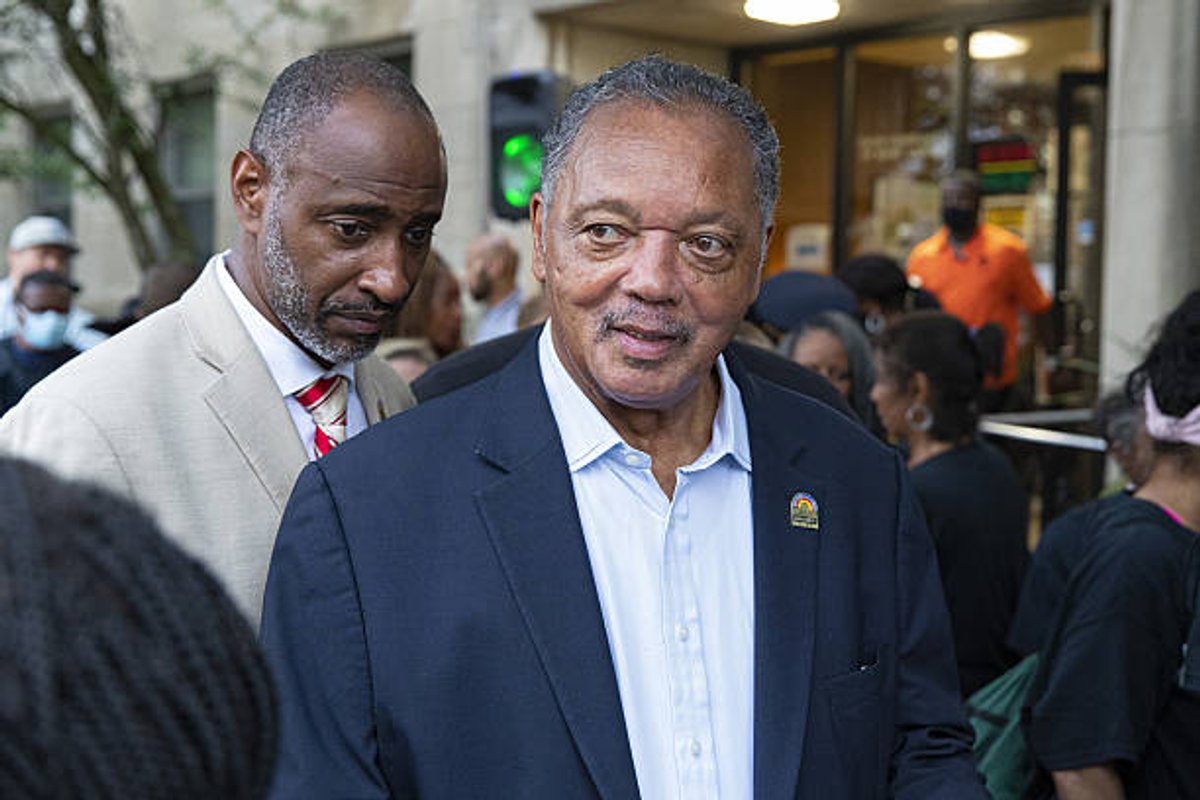
WASHINGTON, Feb 17, 2026 — The Rev. Jesse Jackson, a towering figure in the American civil rights movement who rose from the segregated South to become a national political force, has died at the age of 84, his family announced Tuesday.
Jackson, an eloquent Baptist minister and longtime advocate for racial and economic justice, was a close associate of Martin Luther King Jr. and later mounted two historic campaigns for the Democratic presidential nomination in the 1980s.
“Our father was a servant leader — not only to our family, but to the oppressed, the voiceless, and the overlooked around the world,” his family said in a statement.
From Segregated South to National Prominence

Born on October 8, 1941, in Greenville, South Carolina, Jackson grew up during the era of Jim Crow segregation. He later became active in civil rights activism while attending North Carolina Agricultural & Technical College, where he participated in protests challenging racial discrimination.
Ordained as a Baptist minister in 1968, Jackson quickly emerged as a prominent voice within the movement led by King. On April 4, 1968, he was in Memphis when King was assassinated, an event that marked a turning point in American history.
Following King’s death, Jackson founded Operation PUSH in Chicago during the early 1970s, aimed at promoting economic empowerment in Black communities. In 1984, he established the National Rainbow Coalition, expanding his advocacy to include women’s rights, LGBTQ rights, and broader social justice initiatives. The organizations later merged into the Rainbow PUSH Coalition.
Historic Presidential Campaigns

Jackson sought the Democratic presidential nomination in 1984 and 1988, becoming one of the first Black candidates to mount competitive national campaigns within a major party.
In 1984, he secured roughly 18% of the vote in Democratic primaries. Four years later, he improved his performance significantly, winning 11 primaries and caucuses and capturing nearly 29% of the vote — an unprecedented showing at the time for a Black candidate.
It would not be until fellow Chicagoan Barack Obama won the presidency in 2008 that a Black candidate achieved a major party nomination and electoral victory at that level.
Jackson never held elective office but remained a powerful national voice for decades.
International Diplomacy and Advocacy

Beyond domestic politics, Jackson engaged in high-profile diplomatic efforts. He helped negotiate the release of Americans detained overseas, including individuals held in Syria, Cuba, Iraq, and Serbia.
During the 1990s, President Bill Clinton appointed Jackson as a special envoy to Africa. In 2000, Clinton awarded him the Presidential Medal of Freedom, the nation’s highest civilian honor.
Jackson also maintained a visible media presence, hosting a weekly program on CNN during the 1990s.
Later Years and Health Challenges
In 2017, Jackson publicly disclosed that he had been diagnosed with Parkinson’s disease after experiencing symptoms for several years. Despite health challenges, he continued speaking out on issues of racial justice, including during nationwide protests in 2020 following the killing of George Floyd.
His death comes amid renewed national debates over civil rights, historical memory, and the direction of American institutions.
A Lasting Legacy
For many supporters, Jackson symbolized perseverance and the expansion of political opportunity. His 1988 Democratic convention speech remains one of the most cited addresses in modern political history, urging Americans to find unity across differences.
“America is not a blanket woven from one thread, one color, one cloth,” he told delegates.
Over more than five decades, Jackson built a reputation as a charismatic orator, grassroots organizer, and international advocate. While his career included controversy, his impact on civil rights and American political life remains substantial.
He is survived by his wife, Jacqueline Brown, their children, and an extended family.